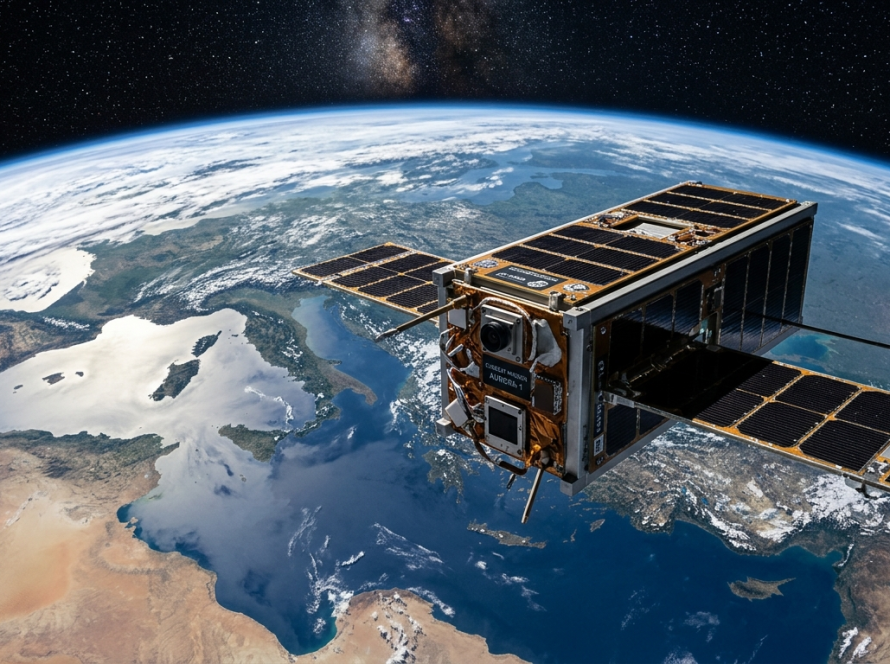
In early 2026, SpaceDyS initiated a nine-month collaboration with the University of Pisa to develop an accurate space debris orbit propagator to be integrated into Orb41, the software of the Celestial Mechanics Group at the Department of Mathematics.
This activity is part of the “Space It Up!” project, which is dedicated to research and innovation in the Italian space sector.
The project involves upgrading Orb41 to generate a Low Earth Orbit (LEO) debris catalog based on optical and radar observations, and to detect potential conjunctions between satellites and space debris. Leveraging the expertise acquired in the SUTED and SUTED4LEO projects for ASI, SpaceDyS will develop a new propagator based on a high-order adaptive step-size Runge-Kutta integrator. This will ensure greater accuracy and efficiency compared to current fixed-step methods, particularly for highly eccentric orbits. Furthermore, a simplified optical and radar observation simulator will be developed, which will account for geometric observability conditions and the magnitude of the observed objects.